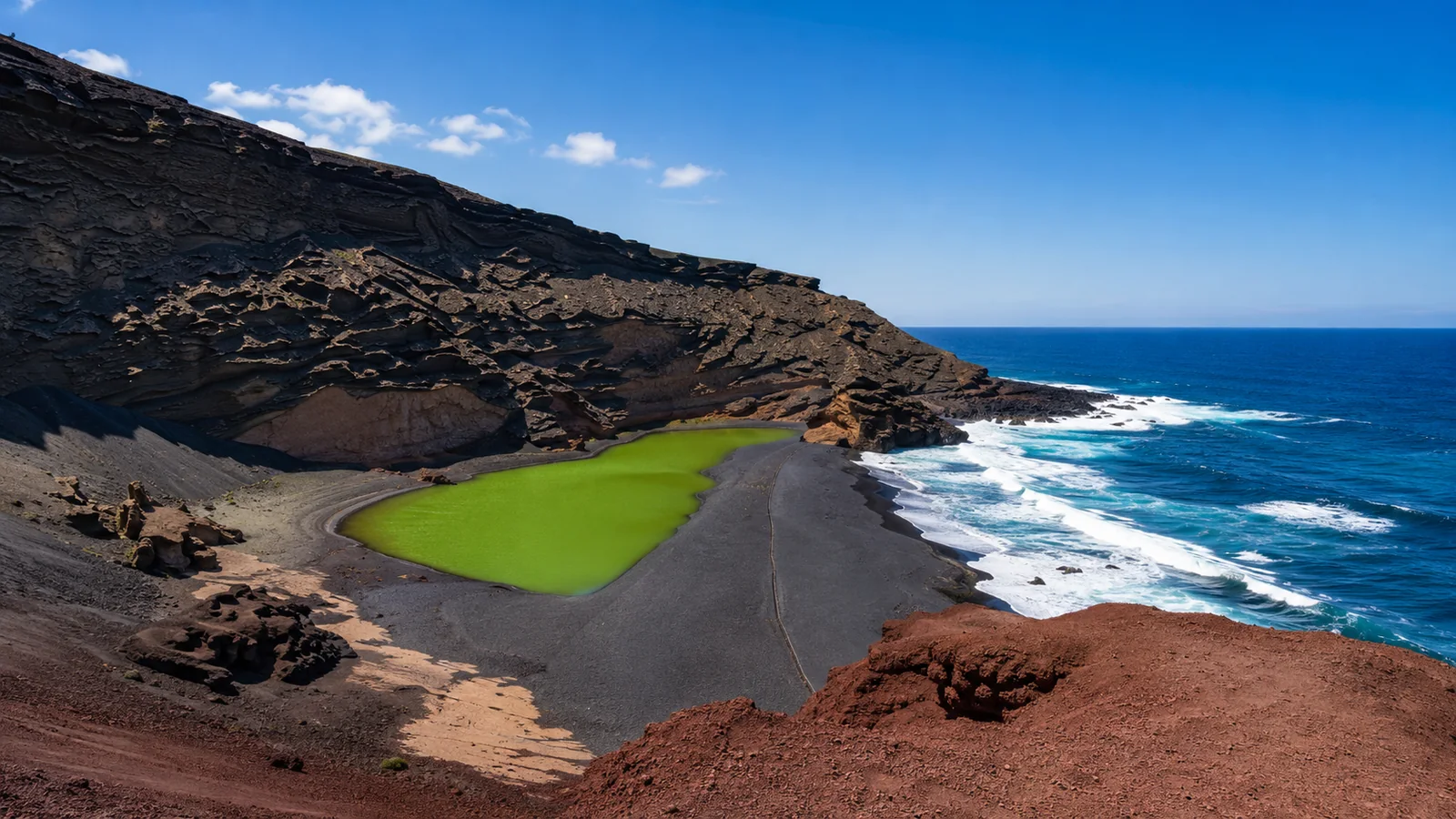
El Golfo is one of Lanzarote’s most striking coastal stops: a small fishing village beside black volcanic shore, powerful Atlantic waves and the vivid green lagoon known as Charco de los Clicos. The view is instantly recognisable. From the official viewpoint, a crescent of dark sand curves around bright green water, backed by layered volcanic cliffs and open ocean. It is a short visit if you only take the photograph, but spending a little longer reveals a place with geology, local character and an especially memorable west-coast atmosphere.
El Golfo works beautifully as part of a route through southern and western Lanzarote. It is close to the Timanfaya volcanic landscape, the salt pans of Janubio and the coastal road towards Playa Blanca. Come with realistic expectations: the lagoon is for viewing, not swimming, and the Atlantic can be rough. In return, you will see one of the island’s most unusual natural contrasts, where black sand, green water and red-brown rock meet in one compact scene.
Charco de los Clicos: Lanzarote’s green lagoon
The green lagoon is the reason most visitors come to El Golfo. Its colour is created by a combination of algae and the particular conditions within the partially enclosed water, while the black volcanic sand around it intensifies the effect. The lagoon sits inside the remains of an old volcanic crater that has been opened to the sea by erosion. Looking across it from the viewpoint, you can read much of Lanzarote’s story in a single frame: volcanic activity created the land, then wind and Atlantic waves slowly reshaped it.
The site is protected, so visitors should admire the lagoon from the designated paths and viewing area rather than trying to reach the water. Swimming in Charco de los Clicos is not permitted and is not safe. Respecting the barriers is part of protecting the delicate ecosystem as well as the eroded crater edge. The viewpoint is close to the village and requires only a short, easy walk, making it a rewarding stop for families, photographers and anyone who wants a dramatic landscape without a demanding hike.
A volcanic coast shaped by wind and waves
El Golfo lies on Lanzarote’s western side, where the Atlantic arrives with more force than on many sheltered east-coast beaches. The coastline is constantly changing on a geological timescale: waves cut into old craters, expose coloured layers of rock and deposit dark mineral-rich sand along the shore. The result is much more rugged than a typical sunbathing beach. It feels open, elemental and especially atmospheric when the sea is active.
Look carefully at the cliffs from the viewpoint. You can often see different shades of brown, red, ochre and charcoal, each related to volcanic materials and weathering. The contrast is strongest in clear afternoon light, but overcast weather has its own drama too. A grey sky can make the green lagoon and black beach look even more intense. For that reason, do not cancel a visit just because the forecast is not perfect for swimming; El Golfo is a landscape experience first.
How to get to El Golfo
El Golfo is in the municipality of Yaiza, on the west coast of Lanzarote. A rental car is the easiest way to visit, and the journey is straightforward from Playa Blanca, Puerto del Carmen, Costa Teguise or Arrecife. Use Google Maps for El Golfo and follow the signs into the village. There is parking near the waterfront and around the access to the viewpoint, though spaces can be busy around lunchtime and at sunset.
If you are combining El Golfo with Timanfaya, allow enough time to enjoy both places rather than rushing. The drive between them is scenic and takes you through a very different volcanic environment: Timanfaya is all recent-looking lava fields and cones, while El Golfo is defined by erosion, ocean and older volcanic slopes. Organised excursions sometimes include both stops, but travelling independently lets you choose a quieter time and linger for a meal in the village.
What to see and do in the village
Start with the lagoon viewpoint, then take time to walk down towards the waterfront. El Golfo remains a small fishing village, and its low buildings, boats and restaurants give it a relaxed, lived-in feel. The village beach is dark and beautiful to look at, but it is not generally the place for a casual swim when the Atlantic is rough. Keep a sensible distance from the waterline, especially if waves are breaking strongly over the rocks.
Seafood is a natural part of an El Golfo visit. Restaurants along the waterfront are known for fresh fish, local potatoes and simple Canarian dishes. It is wise to view the menu, ask what is fresh that day and choose the place that suits your budget and pace. A long lunch with a sea view can be the perfect follow-up to the viewpoint, while an early dinner gives you a chance to see the light soften over the coast. In busy holiday periods, booking ahead is a good idea.
Best time to visit and photography tips
Late afternoon is especially popular because the west-facing coast catches warm light before sunset. This is when the colours of the cliffs and lagoon can feel richest, but it is also when parking and the viewpoint are busiest. Morning visits are calmer and can work very well if you are driving a full-day route around the south of the island. If you prefer photos with fewer people, arrive early, walk the path patiently and avoid blocking narrow areas while others are trying to enjoy the view.
A wide-angle view is ideal for showing the crater, lagoon and sea together, but a phone camera can produce lovely results too. Do not climb beyond the marked viewpoint for a better angle. The edges are unstable in places and the barrier exists for a reason. Wind can be strong, so secure hats, loose scarves and camera straps. On a clear day, the bright contrast may fool an automatic camera exposure; tap the green lagoon on your phone screen and take a few versions before moving on.
What to bring and practical advice
For a short visit, take water, sun protection and a light layer. Even on a warm day, the wind on the west coast can feel cooler than in sheltered resorts. Comfortable shoes are better than flip-flops if you plan to use the uneven paths around the viewpoint or combine El Golfo with another walk. A hat with a strap is useful, and sunglasses help with the bright reflection from ocean and black sand.
There is no entry ticket for the public viewpoint, so El Golfo is an easy addition to a self-drive itinerary. The important “booking” is really time: do not arrive with only five minutes to spare before a restaurant reservation or sunset. Give yourself at least forty-five minutes to walk, look and take photographs, or longer if you want lunch. The parking and paths are simple, but the experience is far more enjoyable when it is unhurried.
Build a west-coast Lanzarote itinerary
El Golfo pairs naturally with several nearby sights. Timanfaya National Park is the obvious companion and gives you the full volcanic contrast between inland fire mountains and ocean erosion. Continue south to the Salinas de Janubio for geometric salt pans and another photogenic coastal scene. You can then return towards Playa Blanca, perhaps stopping at Los Hervideros to see waves surge through volcanic cavities when the sea is lively.
If you start from Puerto del Carmen or Costa Teguise, plan El Golfo as a half-day or full-day route rather than a quick detour. The roads are easy, but the island is more enjoyable when you make room for unexpected viewpoints, a slow meal or a change in the weather. Avoid packing too many fixed commitments into one day; the landscape is the main reason to be out here.
A small stop with a big sense of place
El Golfo is not about entertainment facilities or a long list of attractions. Its appeal is more direct: the sound of the Atlantic, the surreal green of Charco de los Clicos, black sand under the cliffs and the welcoming rhythm of a fishing village. Visit respectfully, keep to the marked paths and let the place set the pace. Whether you stay for a viewpoint, a seafood lunch or an evening on the coast, El Golfo is one of the clearest reminders that Lanzarote is a living volcanic island shaped by the sea.