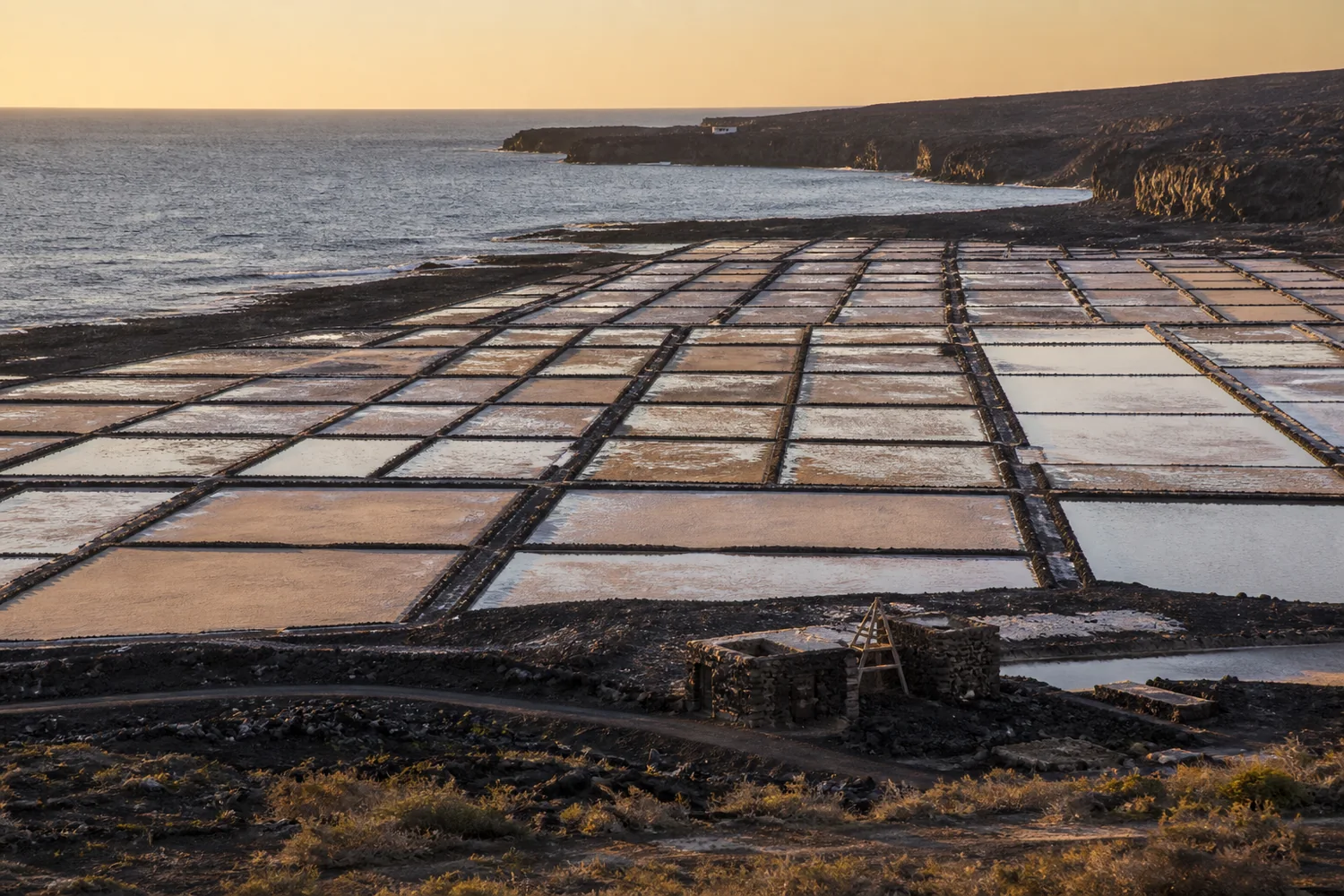
Salinas de Janubio is one of Lanzarote’s most beautiful working landscapes. On the island’s south-west coast, shallow salt pans form a geometric patchwork of whites, silvers, pinks and blues beneath volcanic hills. The Atlantic is close, the wind is almost always present and the low winter sun can turn the whole scene into a quiet piece of art. From a distance, the salt flats look abstract; up close, they reveal the patient craft of making sea salt by hand.
This is more than a viewpoint stop. Janubio tells a story about fishing, food, local industry and the ways people have adapted to Lanzarote’s dry, windy environment. It is especially rewarding if you take a guided visit, where the ponds, channels, mills and crystallisation process begin to make sense. Even a short stop for photographs is worthwhile, but a little context transforms the colours and shapes into something much richer.
The largest salt flats in the Canary Islands
The Janubio Salt Flats are widely described as the largest salt flats in the Canary Islands. They sit in a natural coastal depression near Yaiza, where human engineering and the local climate work together. Sea water is guided through a carefully planned hydraulic system into shallow ponds. Sun and wind gradually encourage evaporation, increasing the concentration of salt until crystals can be collected. It is a deceptively simple process that depends on weather, timing and a great deal of practical knowledge.
The landscape’s colours shift with the season, light and water levels. On one day the pans may look bright white and reflective; on another, algae and minerals produce subtle green, rose or ochre tones. The salt flats are therefore a favourite for photographers, but they are also a living production space. Respect the boundaries, avoid walking on the pans unless you are on an authorised guided route and never disturb the water channels or salt piles.
A history of salt and island life
Salt was essential to Lanzarote’s fishing economy because it preserved fish before modern refrigeration. Janubio developed as a major salt-producing site in the nineteenth century, serving local needs and wider trade. The work connected the coast with inland communities, boats with food preservation and traditional skills with the daily life of the island. Today the salt flats remain active and have become an important cultural landscape as well as a source of high-quality sea salt and flor de sal.
That continuity matters. Visiting Janubio is not like looking at a museum display behind glass; it is an opportunity to see a heritage craft that still has a practical purpose. The official Salinas de Janubio visitor information describes the site as the only saltworks in the Canary Islands to have remained in continuous operation. When you buy a local salt product or book a visit, you are supporting the work that helps keep this landscape alive.
How salt is made at Janubio
The guided route explains the journey from sea water to crystal. Water enters the system and moves through pools where evaporation becomes progressively more intense. As conditions change, different salts and minerals behave differently, and salt workers watch the process closely. Eventually the concentrated brine reaches crystallisation areas, where sea salt can be harvested. The work is manual, seasonal and sensitive to wind, cloud and rain.
Flor de sal is the delicate layer of crystals that forms on the surface under the right conditions. It is harvested carefully and is prized for its texture and gentle flavour. A tasting makes the difference easy to understand: this is not simply “saltier salt”, but a product with a distinct structure and a close connection to place. If you enjoy cooking, a small packet of Janubio salt is a practical and meaningful souvenir from Lanzarote.
How to get to Salinas de Janubio
The salt flats are near the south-western coast of Lanzarote, in the municipality of Yaiza. A rental car is the easiest way to visit. Use Google Maps for Salinas de Janubio and follow the road towards Los Hervideros and Janubio. There is parking around the visitor area and nearby viewpoints, but always use designated spaces and avoid stopping on narrow road edges for photographs.
Janubio fits naturally into a south-and-west Lanzarote route. It is close to El Golfo, Los Hervideros and the road towards Playa Blanca, so it can be a lovely stop between volcanic coast scenery and a meal. From Puerto del Carmen or Costa Teguise, allow enough driving time to make the visit feel unhurried. The west coast is often breezy, and the journey is much more enjoyable when you are not trying to catch a fixed reservation at the last minute.
Guided tour, tasting and booking
The best way to understand Janubio is through the official guided visit. Salinas de Janubio currently describes a walking tour of approximately 90 minutes, available in Spanish and English, with an explanation of the traditional production process and a tasting of Flor de Sal and the site’s flavoured salts. Places are limited, so reserve ahead through the official Salinas de Janubio visit page, especially if you want a particular language or date.
At the time of publication, the official tourism listing shows a standard adult price of €22, child rates for ages 6–12 and free entry for younger children, but rates and schedules can change. Check the current calendar directly before making plans. The site advises comfortable clothes and shoes, a hat and sunglasses because sunlight on the salt can be extremely bright. The guided route is low difficulty, although it is not wheelchair accessible; contact the operator directly for the latest advice if accessibility is important for your group.
The free viewpoint and photography
You do not need a guided tour to appreciate the broad view of the salt flats. A roadside viewpoint near the area offers one of the classic panoramas: gridded ponds in the foreground, volcanic land behind and the Atlantic beyond. It is an excellent photo stop, especially in late afternoon. Treat it with care, though. Park safely, keep clear of working access and do not cross into the salt pans for a “better angle”. The visual impact is just as strong from permitted areas.
Sunset is popular because the light can bring warm gold and pink tones to the water. Do not assume it will be a perfect mirror every evening; wind and working conditions are part of the scene. On a cloudier day, the patterns and contrast between white salt and black volcanic ground can be just as beautiful. Bring a camera or phone, but also give yourself time to simply observe how the colours change.
What to bring and how to visit responsibly
Take water, sunscreen, a hat with a secure fit, sunglasses and closed, comfortable shoes. The surface can be uneven and the reflected light from salt is intense. A light windproof layer is sensible on the exposed coast. Avoid bringing large bags on the guided walk, and keep hands free for balance where paths are uneven.
Janubio is a working heritage landscape, so follow staff instructions at all times. Do not touch salt piles or equipment, leave nothing behind and keep children close to the route. If you buy salt, store it carefully in a dry bag. Above all, do not confuse a production site with an open beach. The rules are simple and help protect the quality of the salt, the safety of visitors and the future of the place.
Combine Janubio with the west coast
El Golfo and Charco de los Clicos are an easy drive north from Janubio, offering a vivid green lagoon and a very different volcanic coast. Los Hervideros is another nearby stop, where Atlantic waves surge through lava formations when the sea is active. Timanfaya National Park lies inland and makes a powerful contrast with the salt flats: fire-shaped landscapes in the morning, sea and salt in the afternoon.
Finish near Playa Blanca or Yaiza for dinner, but keep a little flexibility in your schedule. Strong wind, bright sun and changing weather all contribute to Janubio’s character. A visit here is a reminder that Lanzarote’s most memorable places are often built from simple elements: sea water, sun, wind, volcanic rock and generations of patient work.